


How to achieve Carbon Neutrality by 2050
Carbon neutrality has become one of the central objectives of global climate policy. With the 2015 Paris Agreement, countries committed to limiting global temperature rise to well below 2°C above pre-industrial levels, while pursuing efforts to stay within 1.5°C.
In Europe, the European Green Deal and the European Climate Law set a clear target: achieving climate neutrality by 2050. Reaching this goal requires a profound transformation of energy systems, industrial processes, and economic models, combining deep emission reductions with strategies to address the CO₂ already accumulated in the atmosphere.
But what does becoming carbon neutral actually mean?
What does Carbon Neutrality mean?
Carbon neutrality is achieved when the amount of carbon dioxide emitted into the atmosphere is balanced by an equivalent amount of CO₂ removed or compensated.
This does not necessarily mean eliminating all emissions. Instead, it means ensuring that any remaining emissions are neutralized through credible mechanisms, so that the overall carbon balance equals zero.
In practice, carbon neutrality combines emission reductions with solutions that either compensate for or permanently remove residual CO₂.
Carbon Neutral, Climate Neutral, and Net Zero: what’s the difference?
Although often used interchangeably, these terms have distinct meanings.
- Carbon Neutral refers specifically to balancing carbon dioxide emissions.
- Climate Neutral goes further by including all greenhouse gases, such as methane and nitrous oxide.
- Net Zero is the most comprehensive and scientifically robust concept. It requires deep emission reductions across the entire value chain and allows only unavoidable residual emissions to be balanced through permanent carbon removal.
Today, Net Zero is widely regarded as the most credible long-term climate target for governments and corporations alike.
Which countries emit the most CO₂?
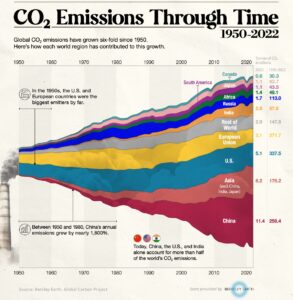
At a global level, the largest annual CO₂ emitters are China, the United States, and India, followed by the European Union as a bloc and Russia.
China currently accounts for the largest share of annual emissions, while the United States remains one of the largest contributors in terms of cumulative historical emissions.
It is important to distinguish between total emissions, per capita emissions, and historical responsibility. These different metrics offer different perspectives on global climate responsibility and action.
How much does Italy emit compared to other countries?
Italy accounts for roughly 1% of global CO₂ emissions. Over recent decades, the country has progressively reduced its emissions thanks to improvements in energy efficiency, expansion of renewable energy, and a lower carbon intensity in electricity generation.
However, sectors such as heavy industry, cement, steel, long-distance transport, and aviation remain difficult to fully decarbonize. These hard-to-abate sectors represent one of the main challenges on the path to climate neutrality and highlight the importance of complementary solutions such as carbon removal.
Actions required to achieve Carbon Neutrality by 2050
Reaching carbon neutrality requires a systemic and integrated approach. The transition is built on several interconnected pillars.
- The first is the rapid reduction of emissions through renewable energy deployment, electrification, efficiency improvements, and circular economy strategies.
- The second involves transforming industrial systems through innovation, including low-carbon fuels, hydrogen, and carbon capture technologies.
- The third pillar addresses residual emissions that cannot yet be eliminated. These must be managed responsibly through high-integrity solutions, increasingly including permanent carbon removal.
Without combining these elements, the 2050 objective becomes significantly harder to achieve.
Carbon Offsetting: compensating for CO₂ emissions
Carbon offsetting involves financing projects that avoid or reduce emissions elsewhere in order to compensate for one’s own emissions. Examples include reforestation initiatives, renewable energy installations, and efficiency projects.
While offsetting can support climate mitigation in the short term, it does not replace the need for direct emission reductions. Moreover, some offset projects raise concerns regarding permanence, additionality, and long-term climate impact.
As climate standards evolve, there is growing emphasis on ensuring that offset mechanisms are transparent, verifiable, and aligned with science-based targets.
Carbon Removal: removing CO₂ from the atmosphere
Carbon removal refers to the active extraction of CO₂ from the atmosphere followed by its durable storage.
Unlike avoidance or reduction projects, carbon removal addresses both residual emissions and the legacy carbon accumulated since the industrial revolution. This makes it a critical component of any realistic Net Zero strategy.
Carbon removal approaches include nature-based solutions such as reforestation, as well as technological pathways like bioenergy with carbon capture, mineralization, and Direct Air Capture (DAC).
According to leading climate scenarios, large-scale deployment of carbon removal will be necessary to achieve global climate targets by 2050. Emission reductions alone will not be sufficient.
Frequently Asked Questions
-
Can CarpeCarbon help me become Carbon Neutral?
CarpeCarbon develops Direct Air Capture (DAC) technologies designed to permanently remove CO₂ from the atmosphere. This means we can support companies and organizations that, after reducing their emissions as much as possible, need to neutralize the remaining hard-to-abate emissions.
A credible carbon neutrality strategy does not rely solely on compensation. It begins with measuring emissions, continues with structural reductions across operations and value chains, and is completed by permanently removing the residual share. Carbon removal technologies represent this final and increasingly essential step in any robust Net Zero pathway.
-
Is offsetting CO₂ emissions enough to be Carbon Neutral?
In recent years, many carbon neutrality strategies have relied primarily on carbon offsetting, meaning the financing of projects that avoid or reduce emissions elsewhere. While offsetting can play a role, scientific consensus and evolving international standards indicate that it is not sufficient on its own to align with the goals of the Paris Agreement.
To follow a credible Net Zero trajectory, organizations must first significantly reduce their direct emissions and limit offsetting to unavoidable residual emissions. In these cases, integrating permanent carbon removal solutions becomes essential to ensure environmental integrity and long-term impact.
-
Are there already carbon-neutral countries?
Some countries have declared carbon neutrality or have achieved net-negative emissions, often due to extensive forest coverage and relatively low levels of industrialization. Bhutan and Suriname are frequently cited examples, as they absorb more CO₂ than they emit.
However, for large industrialized economies, the challenge is far more complex. Achieving carbon neutrality requires deep transformations across energy systems, transportation, heavy industry, and land use, alongside the deployment of scalable carbon removal solutions.
-
What are Carbon Credits?
Carbon credits are certificates representing one metric ton of CO₂ that has been avoided, reduced, or removed. They can originate from projects that prevent new emissions, such as renewable energy installations or efficiency improvements, or from initiatives that actively remove CO₂ from the atmosphere and store it durably.
The quality of a carbon credit depends on strict criteria, including additionality, permanence, and independent verification. In recent years, the voluntary carbon market has been evolving toward more rigorous standards, particularly for high-durability carbon removal credits. We talked about them here: Carbon credits: a term everyone’s heard, but is it truly understood? – CarpeCarbon
-
Is achieving Carbon Neutrality by 2050 realistic?
Reaching carbon neutrality by 2050 is an ambitious objective, but it is widely considered necessary by the scientific community to limit the most severe impacts of climate change. Its feasibility will depend on the speed of the energy transition, technological innovation, and the large-scale deployment of emerging climate solutions.
Climate scenarios consistently show that emission reductions alone will not be enough. Significant volumes of CO₂ removal will also be required to balance residual emissions and address the legacy carbon already accumulated in the atmosphere. Carbon neutrality, therefore, is not only about reducing future emissions, but also about actively managing the carbon of the past.