
How to reach Carbon Neutrality by 2050?
Carbon neutrality is now one of the central objectives of global climate policies. With the Paris Agreement, signed in 2015, the world’s countries committed to keeping the global temperature increase well below 2°C compared to pre-industrial levels, ideally aiming for 1.5°C.
In Europe, the European Green Deal and the European Climate Law set a clear goal: to achieve climate neutrality by 2050. This means profoundly transforming energy, industrial, and production systems, drastically reducing emissions, and also addressing the CO₂ already accumulated in the atmosphere.
But what does becoming carbon neutral actually mean in practice?
What does Carbon Neutrality mean?
Carbon neutrality is achieved when the amount of carbon dioxide (CO₂) emitted is balanced by an equivalent amount of CO₂ removed or offset.
In other words:
Emissions produced – CO₂ removed = 0
This does not necessarily imply zeroing all emissions, but ensuring that residual ones are neutralised through:
- direct reductions,
- offsetting,
- permanent removal of CO₂ from the atmosphere.
Carbon neutral, Climate neutral, and Net Zero: what are the differences?
These terms are often used as synonyms, but they have important differences.
Carbon Neutral
Refers exclusively to CO₂. Carbon dioxide emissions are balanced through offsets or removals.
Climate Neutral
Includes all greenhouse gases (methane, nitrous oxide, fluorinated gases), not just CO₂.
Net Zero
Is the most rigorous concept: it implies a drastic reduction of emissions across the entire value chain and the neutralisation of only “hard-to-abate” residual emissions through permanent removals.
The concept of Net Zero is now considered the most credible standard at a scientific and political level.
Which countries have the highest CO2 emissions?
Globally, the highest annual CO₂ emissions come from:
- China
- United States
- India
- European Union (considered as a whole)
- Russia
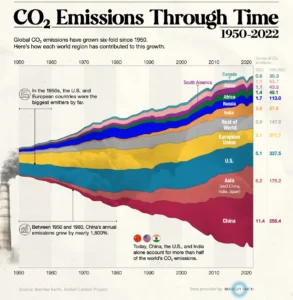
China is currently the world’s top emitter in absolute terms, while the United States has historically contributed significantly to cumulative emissions.
However, it is essential to distinguish between:
- total emissions,
- per capita emissions,
- historical cumulative emissions.
These three metrics tell very different stories of responsibility and dynamics.
How much does Italy emit compared to other countries?
Italy accounts for approximately 1% of global CO₂ emissions.
In recent decades, it has recorded a progressive reduction in emissions thanks to:
- greater energy efficiency,
- growth of renewables,
- reduction of carbon intensity in the electricity sector.
However, sectors such as heavy industry, cement, steel, transport, and aviation remain difficult to decarbonise completely. This is precisely where complementary solutions like carbon removal come into play.
Actions to reach Carbon Neutrality by 2050
Achieving neutrality requires an integrated approach. The main levers are:
1️⃣ Emission reduction
- Transition to renewable energy
- Electrification of consumption
- Energy efficiency
- Circular economy
2️⃣ Industrial decarbonisation
- Green hydrogen
- E-fuels
- CO₂ capture in industrial processes
3️⃣ Offsetting residual emissions
- Certified carbon offset projects
4️⃣ Permanent CO₂ removal
- Direct Air Capture (DAC)
- Bioenergy with Carbon Capture and Storage (BECCS)
Carbon Offsetting: Offsetting CO2 emissions
Carbon offsetting consists of financing projects that avoid or reduce emissions elsewhere to compensate for one’s own emissions.
Examples include reforestation activities, renewable energy projects, or energy efficiency improvements.
Offsets can be a useful tool in the short term, but they do not replace the need to drastically reduce direct emissions. Furthermore, they do not always guarantee permanence or additionality in the long term.
Carbon Removal: Removing CO2 from the atmosphere
Carbon removal represents a crucial step towards reaching Net Zero.
Unlike offsetting, removal involves the active extraction of CO₂ already present in the atmosphere and its permanent storage.
Key technologies include:
- bioenergy with capture and storage
- mineralisation
- Direct Air Capture (DAC)
According to the international scientific community, without large-scale CO₂ removals, it will be impossible to reach the 2050 climate goals.
In addition to offsetting residual emissions from hard-to-abate sectors, carbon removal also allows for addressing historical CO₂ already accumulated in the atmosphere over the last two centuries. For this reason, permanent and scalable CO₂ removal is becoming an increasingly central pillar in European and global climate strategies.
Frequently Asked Questions
Can CarpeCarbon help me become Carbon Neutral?
CarpeCarbon develops Direct Air Capture (DAC) solutions for the permanent removal of CO₂ from the atmosphere.
This means we can contribute to the climate strategy of companies and organisations that, after reducing their emissions as much as possible, must neutralise those residual ones that are difficult to eliminate.
A solid carbon neutrality strategy is not limited to offsetting, but starts with measuring emissions, continues with their structural reduction, and is completed with the permanent removal of the residual portion. Carbon removal technologies represent exactly this final step, which is increasingly central to credible Net Zero strategies.
Is offsetting CO2 emissions enough to reach Carbon Neutrality?
In recent years, many carbon neutrality initiatives have relied predominantly on offsetting emissions through projects that avoid or reduce emissions elsewhere. However, according to the latest scientific and international standards, offsetting alone is not considered sufficient to achieve climate goals consistent with the Paris Agreement.
To be truly aligned with a Net Zero pathway, it is necessary to significantly reduce direct emissions and limit the use of offsetting to unavoidable emissions only. In these cases, the integration of permanent CO₂ removals becomes a key element to ensure credibility and environmental integrity.
Do Carbon Neutral countries already exist?
Some countries have declared that they have reached climate neutrality or are in a state of positive net absorption, thanks mainly to the high presence of forests and limited industrialisation. Among the most cited cases are Bhutan and Suriname, which absorb more CO₂ than they emit.
For industrialised economies, however, the path is much more complex. Reaching carbon neutrality requires profound transformations in energy systems, transport, industry, and land use, as well as the integration of large-scale removal solutions.
What are Carbon Credits?
Carbon credits are certificates representing one tonne of CO₂ avoided, reduced, or removed from the atmosphere. They can derive from projects that prevent new emissions, such as renewable plants or energy efficiency interventions, or from initiatives that actively remove CO₂ and store it durably.
The quality of a credit depends on rigorous criteria such as additionality, permanence of storage, and independent verification. In recent years, the carbon credit market has been evolving towards more transparent and stringent standards, especially regarding permanent removals. We discussed it here: Carbon credits: do we know what they are? – CarpeCarbon
Is the 2050 Carbon Neutrality goal realistic?
Reaching carbon neutrality by 2050 is an ambitious goal, but considered necessary by the scientific community to limit the most severe impacts of climate change. Its feasibility will depend on the speed of the energy transition, technological innovation, and the ability to scale solutions that are still in the development phase today.
International climate scenarios indicate that emission reduction alone will not be enough: it will be necessary to significantly integrate the removal of CO₂ already present in the atmosphere as well. Carbon neutrality is therefore not just a matter of cutting future emissions, but also of addressing the legacy of the past.